For researchers, evaluators, students and lecturers who want to learn causal mapping (the method) and Causal Map (the app we build for it). Everything here is free to watch or read, and the app has a free plan for practice. Pick a starting point by the time you have; the rest will keep.
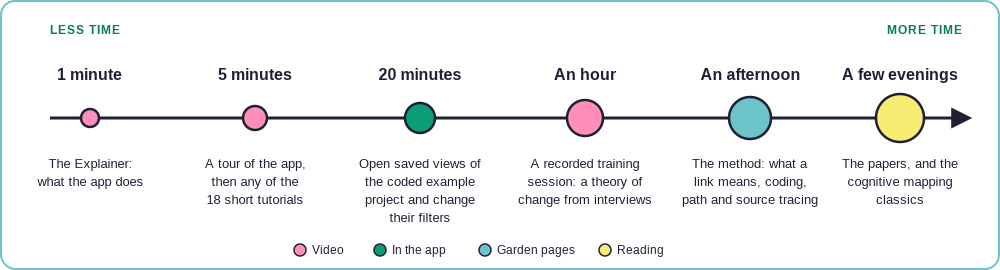
Watch
- Causal Map Explainer (1 min): what the app does.
- Quick tour of cm4 (5 min), then the tutorial playlist: 18 videos of one to seven minutes each, from importing sources and coding by hand to filters, zooming and comparing groups.
- AI coding, with one source (4 min, on the causes of the First World War) and with several sources at once (3 min).
- How to build a real-life theory of change from your interviews using AI (64 min): a whole training session, recorded at gLocal Evaluation Week in June 2026. New videos go on our YouTube channel.
Try
- Sign up free at app.causalmap.app. Projects on the free plan are public (anyone with the link can view them), so keep it for practice texts and published material, never confidential interviews.
- Your account comes with its own practice project,
example-short-uncoded-plus your username: two short interviews to code by hand. Manually code your first project walks you through it. - The public example project,
example-original, holds nineteen coded household interviews. Open a saved view and change its filters: the five factors mentioned by the most households, differences between age groups, or the routes from increased knowledge to improved health that single households told in full. Example views has more. - Step-by-step pages are in the How to chapter; the app's own help is published here too. To collect the interviews with an AI interviewer, see Learning QualiaInterviews.
Read the method
The Garden is our account of the method. A sensible order:
- Causal mapping for outsiders: the idea on one page.
- A link from X to Y means someone believes X influences Y: what an arrow is, and is not.
- The three tasks: gathering, coding and analysing.
- Minimalist coding: coding each claim as a plain "X influenced Y", without turning factors into variables.
- A workflow for causal coding with and without AI: eight steps from planning to a final judgement.
- Hierarchical coding, path tracing, source tracing and the transitivity trap: the moves behind most questions you'll ask of a map.
- The glossary and a bibliography of causal mapping.
- Steve Powell's LinkedIn newsletters: Causal mapping, evaluation, AI (method) and Causal Map Highlights (stories from the app).
Read the papers
Our own work first, then the classics.
- Powell et al. (2024): start here. The approach as a whole, from coding causal claims in text to reading the map.
- Powell & Caldas Cabral (2025): AI coding of causal claims, tested against coding by human experts.
- Powell et al. (2025): an AI-assisted pipeline for gathering and analysing stakeholders' stories at scale.
- Caldas Cabral & Powell (2026): AI-assisted causal mapping as a way to hear from more people in an evaluation.
- Remnant et al. (2025): the method applied to evaluating health services.
- Copestake et al. (2019): case studies of the Qualitative Impact Protocol (QuIP), which collects and codes people's own accounts of what changed and why.
- Where it comes from: Axelrod (1976) on the cognitive maps of political elites, Eden (1992) on what a cognitive map is, and Bryson et al. (2004) on causal mapping in organisations.
I sometimes use AI to help draft these pages, but the final text is ours.
References
Axelrod (1976). Structure of Decision: The Cognitive Maps of Political Elites. Princeton university press.
Bryson, Ackermann, Eden, & Finn (2004). Visible Thinking: Unlocking Causal Mapping for Practical Business Results. John Wiley & Sons.
Caldas Cabral, & Powell (2026). Listening at Scale: AI-Assisted Causal Mapping for Inclusive Evaluation. https://doi.org/10.4322/rbaval.202600222026.
Copestake, Morsink, & Remnant (2019). Attributing Development Impact: The Qualitative Impact Protocol Case Book. Practical Action Publishing. https://doi.org/10.3362/9781780447469.
Eden (1992). On the Nature of Cognitive Maps. https://onlinelibrary.wiley.com/doi/10.1111/j.1467-6486.1992.tb00664.x.
Powell, Copestake, & Remnant (2024). Causal Mapping for Evaluators. https://doi.org/10.1177/13563890231196601.
Powell, Caldas Cabral, & Mishan (2025). A Workflow for Collecting and Understanding Stories at Scale, Supported by Artificial Intelligence. SAGE PublicationsSage UK: London, England. https://doi.org/10.1177/13563890251328640.
Powell, & Caldas Cabral (2025). AI-Assisted Causal Mapping: A Validation Study. https://doi.org/10.1080/13645579.2025.2591157.
Remnant, Copestake, Powell, & Channon (2025). Qualitative Causal Mapping in Evaluations. In Handbook of Health Services Evaluation: Theories, Methods and Innovative Practices. https://doi.org/10.1007/978-3-031-87869-5_12.