Summary#
This extension is about using factor labels to carve out a useful subgraph of your causal map.
Like most extensions, it is best thought of as:
- A filter (a rule that takes one links table and returns another), plus
- An interpretation rule (what it means to say we are “focusing on” or “excluding” factors).
There are two closely related operations:
- Focus: keep the causal neighbourhood around one or more “target” factors (their upstream causes and/or downstream consequences).
- Exclude: remove unwanted factors (and therefore remove any links that touch them).
Unlike label-rewrite transforms (collapse synonyms, remove bracket text, zoom hierarchies, combine opposites), focusing/excluding does not rename factors. It decides which parts of the existing graph you want to see and analyse.
How to think about it#
Focus = “show me the neighbourhood around this factor”#
You choose one or more target factors (by label search), then choose:
- how far to look upstream (causes), and
- how far to look downstream (consequences).
The result is a sub-map containing only the links that sit on those upstream/downstream chains.
Focusing is a good way to understand a factor as both:
- an outcome (what leads to it?), and
- an influence (what follows from it?),
without having to interpret the entire map at once.
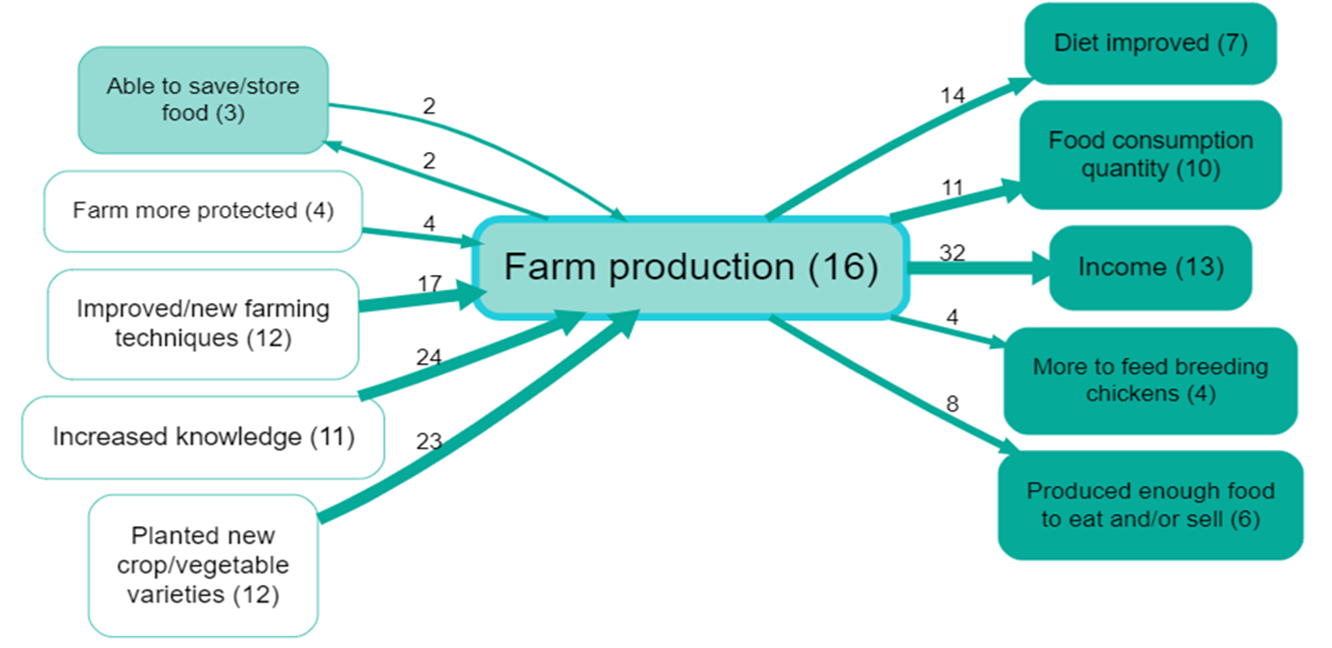
Tip: In interview-style data, chains longer than ~4 steps are uncommon. Large step counts can create hard-to-interpret “hairballs”.
Source tracing = “only keep paths that appear within a single source”#
Sometimes you want coherent within-source narratives rather than a pathway stitched together across respondents.
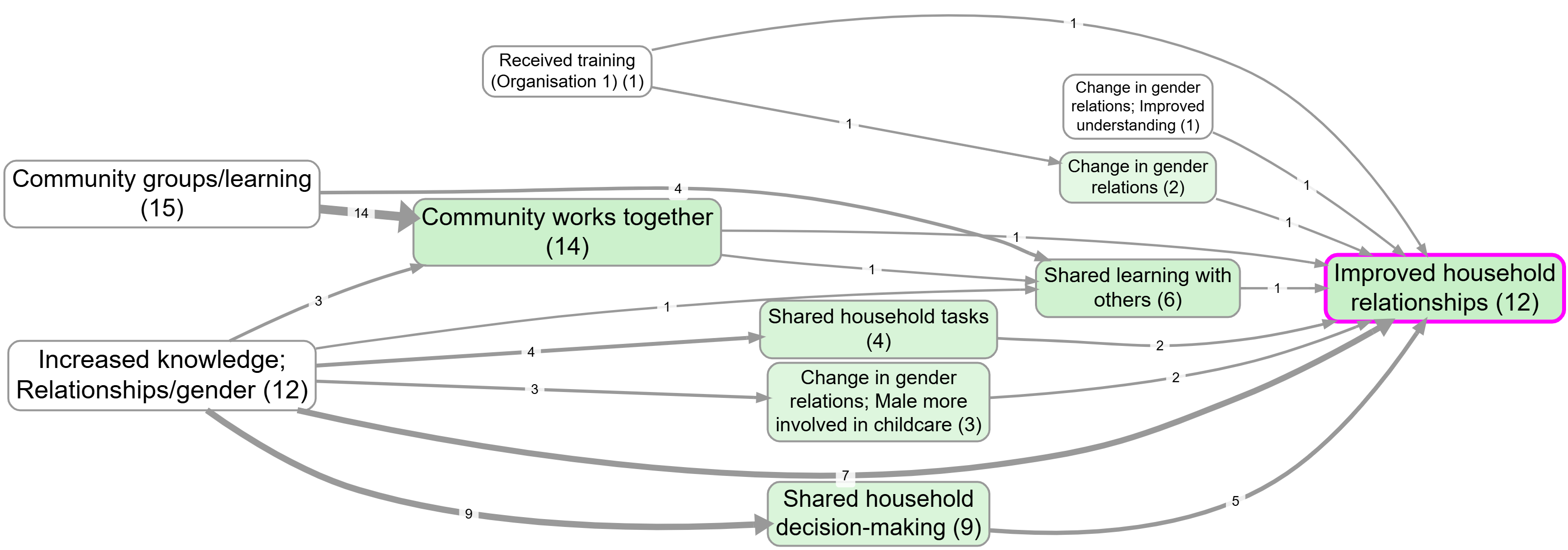
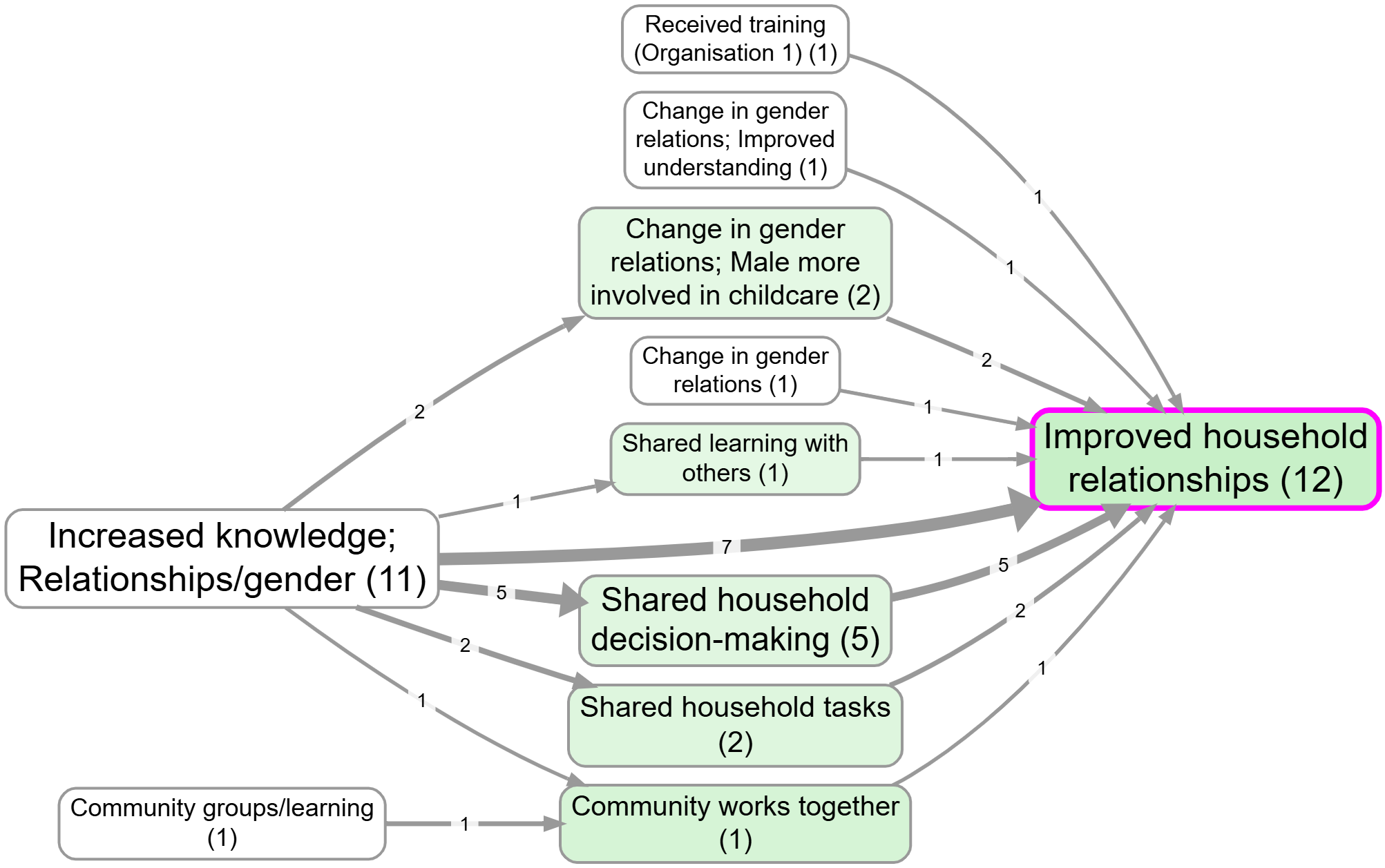
With source tracing on, the focus result becomes more conservative: it keeps only links that lie on at least one upstream/downstream path that can be realised within a single source.
Exclude = “remove these factors (and anything touching them)”#
Exclude is subtractive: you specify one or more unwanted factor patterns, and the app removes:
- the matching factors, and
- any links that touch them (as cause or effect).
Interpretation cautions#
Order matters#
If you apply label-rewrite transforms earlier (collapse, zoom, remove brackets, combine opposites), then focusing/excluding targets are interpreted in terms of the rewritten labels.
Focus is a reading strategy (not a claim about reality)#
Focusing is a way to make a large map interpretable. It does not claim “only this neighbourhood is relevant”; it claims “within N steps, what do sources connect to this factor?”
Relationship to “collapse” (different goal)#
- Use collapse/label-rewrite when you want to treat several labels as the same concept while keeping the surrounding structure visible.
- Use focus when you want to keep the original labels but restrict attention to the local causal neighbourhood of a concept.
Examples (contrasts) from the app#
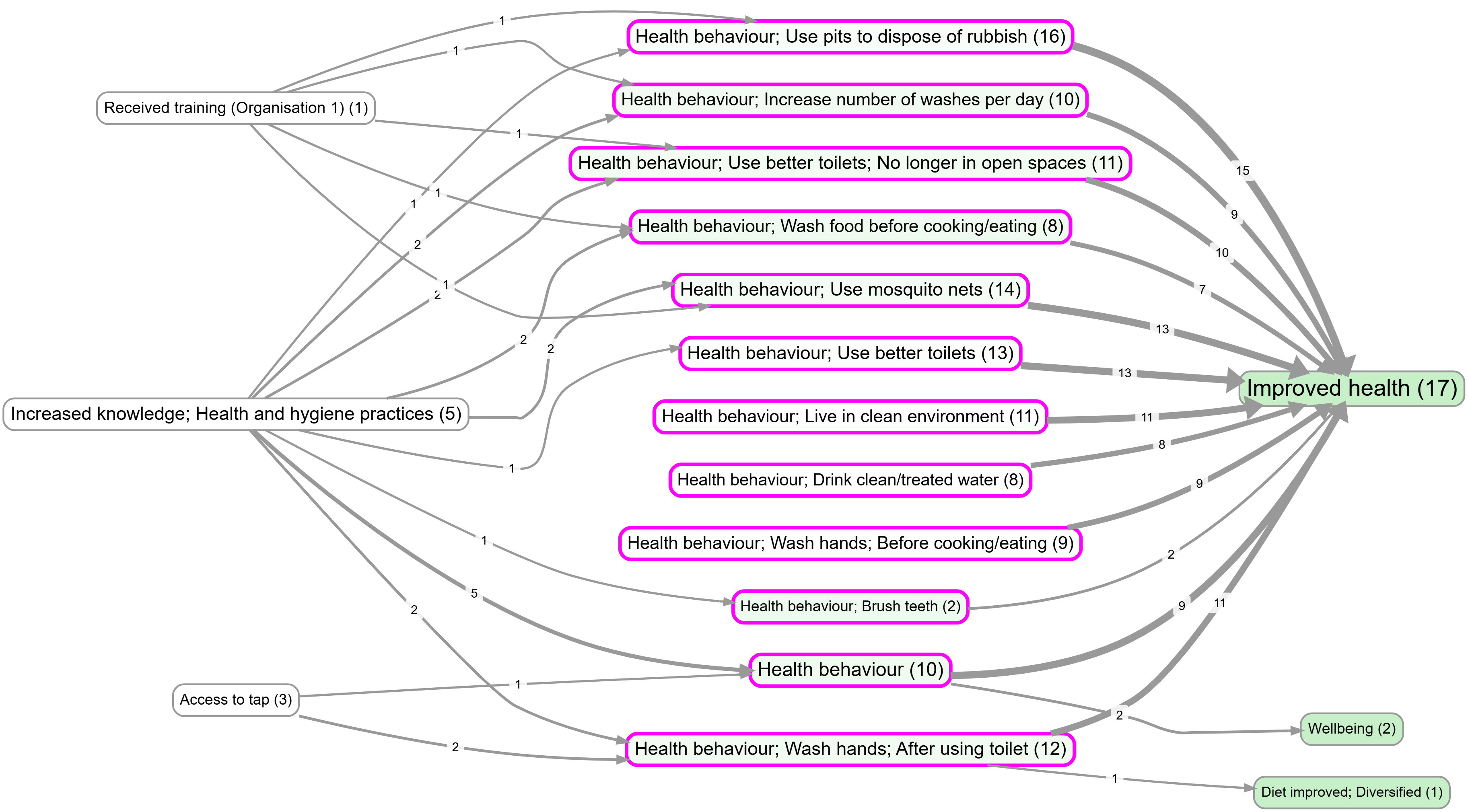
A single-theme focus (one-step neighbourhood)#
Bookmark #982 is a simple example of focusing on one theme and looking at its immediate neighbourhood.
Upstream focus with a single-source constraint (“source tracing”)#
These two bookmarks are both “upstream influences on wellbeing” views, but one requires within-source narrative coherence:
- Without source tracing: bookmark #270
- With source tracing: bookmark #534. Notice how it is more conservative.
Formal notes (optional)#
If you want the precise (link-based) rule, here is the intended definition.
Let \(F\) be the set of focused factor labels, and let \(U\) and \(D\) be the upstream/downstream step limits.
- Keep a link \(x \rightarrow y\) if it lies on any directed path of length \(\le U\) that ends at a factor in \(F\), or any directed path of length \(\le D\) that starts at a factor in \(F\).
- Do not add extra “cross-links” between surviving factors; keep only links that are actually part of the selected paths.
For exclude, let \(E\) be the excluded factor set; remove all links \(x \rightarrow y\) where \(x \in E\) or \(y \in E\).
Transformation and interpretation rules#
Transformation rule#
- Input: a links table plus either (a) focus targets with upstream/downstream step limits, or (b) exclude patterns for factors.
- Transformation: keep links on selected focus paths (optionally with source tracing), or remove links that touch excluded factors.
- Output: a links table/map showing a focused neighbourhood or a reduced graph without excluded factors.
Interpretation rule#
- Focus is a reading strategy for mechanism exploration, not a claim that non-focused parts are unimportant.
- Exclude is an analytical scoping choice; excluded links are omitted for the current view, not invalidated.
See also#
- Formatting your map for what you want to show for how this filter sits in a real workflow.