Summary#
You have a stack of documents or interviews and you want to answer research or evaluation questions rigorously. This is one workflow for getting there: eight steps, from planning through coding to a final judgement. The steps are almost the same whether you code by hand or with AI. This steps presented in this paper match the way we work in the Causal Map app, but the principles should make sense however coding is done. There is a strong focus here on AI-supported coding at scale, as the scale of AI coding requires some additional procedures and checks, but a manual coder follows approximately the same path and can just skip those sections.
Most subscribers to our App have coded manually, and coding manually is great. But although there's a lot of documentation, we never really did a step-by-step guide to how to do manual coding.
At Causal Map we've also been using AI for causal coding systematically now for nearly four years in a set of really interesting studies, mostly for clients, and often at considerable scale. Plenty of subscribers have been asking to use AI themselves. We've been reluctant frankly because we've been making it up as we go along and there are a lot of different things to think about. But now we've introduced One-Click Coding and it's time that we spilled out something of what we have learned on AI coding for the benefit of others.
So that is two overlapping reasons for this working paper. It is written so that a manual coder can read straight past the AI-only parts (the AI decisions table, and the model, chunk and iteration parts of Step 4) and still have a complete workflow.
The steps can be divided into three Tasks. Collect (Steps 1 to 2): decide what questions you want to answer and gather data that can answer them. Code (Steps 3 to 5): turn the text into a checked table of many causal claims, each with a quote and a source. Query (Steps 6 to 8): weigh that evidence and use it to answer the questions. The pattern is one or more cheap, wide coding passes to capture the evidence, then steadily narrower judgement, so a thousand raw claims might end as a few dozen well-vouched links and a few strong findings.
The companion piece, Quality assurance at each step, goes through the same steps and asks how to keep each one rigorous. For step-by-step app instructions in the Causal Map itself, see AI coding.
About causal mapping#
Causal mapping analyses what people say in interviews, focus groups or reports when you want to know what they think causes what. You read the material and code each causal claim ("the rains ruined the harvest", "the training raised her confidence") as a link from one factor to another. Combine the links from many sources and you have a causal map: a network of what people believe drives what. For a fuller introduction see this and this.
It is like systems mapping, but instead of modelling how the world works we first record what people claim about it, and only later, if at all, ask what is really going on.
We code in the minimalist style: a link records only that "a source says X influenced Y", with a quote. No polarity, no strength, no fitted curves, no counterfactual the speaker never gave. The case for that is in Minimalist coding for causal mapping.
The eight steps#
- Collect: Overall planning: questions, methods
- Collect: Gather data
- Code: Prepare and revise the codebook
- Code: Code the claims
- Code: Check links and iterate
- Query: From claims to bundles
- Query: From bundles to pathways
- Query: Judge value, contribution and the final judgement
The steps are not a strict sequence. Sometimes you will iterate. You will revisit the early ones as results come in, and only the last is strictly required; most projects use a handful.
Step 1: Collect#
Start from the question. Before anything else, write down what you want to be able to say at the end, and to whom. Everything downstream, the data you gather, the labels you allow, the columns you add, the queries you run, follows from that.
Be realistic about what causal mapping can and should answer. It is good at: which factors matter most, what influences or follows from a given factor, how different groups see things, how well the evidence supports a pathway or a theory of change, and the overall structure of the system. It will not give you effect sizes, and on its own it does not prove that X causes Y; that judgement stays with you (see Quality assurance at each step of the causal coding workflow). So pick questions the method can serve, and only as many as the evaluation needs. The menu of question types is in the questions chapter.
It helps to sketch, before you code, the map or table that would answer your question: which factors, which comparison, which pathway. That sketch is your target.
Treat the question as a first draft. Causal mapping is partly exploratory, so expect to sharpen it once early coding shows you what the sources actually talk about.
Causal Map's AI assistant, MapCat, can help walk you through these decisions, design and iterate on a corresponding coding plan, and then build a report to answer those questions.
How this fits the wider field#
Causal mapping is rarely the whole of your research or evaluation project. It is an evidence broker: it gathers and organises causal claims as part of your process of making evaluative judgements which may include other approaches. You can see it as belong within the causal pathways family of methods, or perhaps as a tool which feeds into those methods: contribution analysis (Mayne 2012), process tracing (Befani & {Stedman-Bryce 2017; Collier 2011), Outcome Harvesting ({Wilson-Grau 2018; Britt et al. 2025), realist evaluation (Pawson & Tilley 1997), QuIP (Copestake et al. 2019) and Most Significant Change (Davies & Dart 2005). Most real evaluations combine several such methods, what Apgar and Aston call bricolage: you pick and combine the methods to fit the question (Apgar & Aston 2025; Apgar 2024). The nine steps here map onto the four stages they describe for a causal pathways evaluation: design and questions (Steps 1 to 2), methods and data (Step 2), causal analysis (Steps 3 to 7) and assessing the strength of evidence (Steps 6 to 8).
Step 2: Gather data#
The question decides the data. Work out which sources you need, covering what, so the comparisons you care about are possible later. If you will want to compare women and men, or staff and clients, or early and late, those groups have to be in the data and recorded in the source metadata, which Step 5 and the query steps lean on.
Narrative material works best: ask people what changed and why, and you get causal claims to code. QuIP-style "stories of change" are gathered in exactly this way (Copestake et al. 2019).
Gathering data is a subject all of its own and we only touch it here; this focus of this paper is coding and analysis. See .
Step 3: Prepare and revise the codebook#
This step is the same whether you or an AI does the coding: you decide how tightly the labels are fixed in advance, and you organise and revise them as the work goes on. With AI the choice is an instruction; by hand it is your own discipline, but the trade-offs are identical.
You can start from nothing (free coding), from a fixed codebook such as a theory of change, or somewhere between, and you will often revise it more than once.
How free should it be? Four common choices (read "the model" as "you or the model"):
- Forced: only your labels; anything else is dropped.
- Mostly fixed: your labels, but let the model add new ones, flagged (for example
[new]) for review. - Hierarchical compromise: fix the top level, let the model fill in the detail (see Hierarchical coding).
- Free: the model invents everything.
Loose coding finds more but leaves more to tidy; tight coding is cleaner but misses links. If you allow too many off-codebook labels you face a lot of recoding; if you allow too few, your maps thin out and you wonder why you bothered finding the links at all.
Recoding#
Recoding is how you revise the codebook after a first run, which is why it belongs here. Whether you coded by hand or with AI, free coding leaves you with many overlapping labels, and consolidating them is the same job either way (see Different kinds of coding and recoding):
- Hard recode: rewrite the codebook and code again. Most work, best results.
- Links or factors recode: clean up label by label. By hand, edit in the Links or Factors table, use search and replace, or use Bulk Edit; with AI, use AI Answers.
- Soft recode: cluster or magnetise labels into a smaller set.
For organising a large codebook, deciding on a labels-plus-tags system, and bulk rewriting, the recoding paper Different kinds of coding and recoding is the detail; the same tools serve manual and AI coding. Whatever the tool, the principles of consolidating well (how many groups, what a name must do, keeping opposites apart, leaving a label alone) are on Consolidating overlapping labels into a shorter list.
Step 4: Code the claims#
By hand, coding means reading the text, highlighting each causal claim, and recording it as a link from one factor to another with its quote and source. The decisions that follow (labels, hierarchy, when to add a column) apply just as much to manual coding; the rest of this step is the AI mechanics for doing the same thing at scale. For a hands-on first manual project see Manually code your first project.
With AI, coding means writing an instruction, much like a chatbot prompt, that you paste into the app. It tells the app the context and what labels and columns you want. You do not need to add the text itself; the app does that.
In a hurry, or coding just one short text? Press One-click: the app codes with all defaults (claim by claim, no codebook), chunks long texts for you, and joins up the resulting fragments afterwards. Or ask MapCat, the assistant inside the app, which conducts the set-up conversation for you and reports every choice it makes. Both run the same orchestration machinery, described at How the app orchestrates an AI run below. Often that is enough. The rest of this step is for when you want control.
The golden rule: test your instruction on a small, varied sample, work out exactly why the output is wrong or thin, change it, and run again, until you are happy. Then scale up.
Holistic or claim by claim#
Currently not implemented
Currently we do not use holistic coding in the app, as we found that although it tells a coherent story, this is at the expense of some of the links not really being causal. We may re-introduce it in the future. Instead we use join-islands processing to get the bigger picture.
Holistic coding asks the model for one connected diagram per chunk. You get a cleaner, joined-up story, best for a single short text, but the model has more freedom over what to include. (Oddly, asking for a diagram yields better-connected networks than asking for a list of links; under the hood we ask for a diagram and convert it.) Claim-by-claim coding asks for every link separately. You get fuller coverage, better for many texts, but the links join up less and you rely on recoding to rejoin chains: if the text says A to B to C to D and the model codes A to B and C to D with slightly different middles, a later recode has to spot that they match.
| Dimension | Holistic | Claim-by-claim |
|---|---|---|
| Main aim | One connected network | Every link in the text |
| AI freedom | More: it picks the story | Less: it just finds links |
| Connectedness | Higher | Lower; needs recoding to rejoin chains |
| Best for | One short text | Many texts, or exhaustive coverage |
| Recall | Often secondary | Usually as important as precision |
| Repeated claims | May miss them | More likely to catch them |
| Quotes | One per link | One per link |
Holistic versus claim-by-claim coding
Chunk size and sampling#
The more text you give the model at once, the thinner its coding: one page can yield as many links as five. In our experiment series (synthesised here) chunk size mattered more than anything we did to the prompt wording: chunks of 2,000 characters found half as many links again as chunks of 4,000, and a whole 89,000-character document sent in one request returned 6 links where chunked runs returned over 100.
The reason is that models satisfice: given a long stretch of text, they report a plausible handful of claims and stop, whatever the instruction says. But small chunks have their own cost: a cause discussed early in a document and its effect discussed pages later never appear in the same chunk, so the coded map arrives fragmented. The app's orchestration counters both problems: segment accounting obliges the model to account for every paragraph, so large chunks behave more like small ones, and a join-islands pass hunts afterwards for the missing cross-chunk connections, demanding a verified quote for each. Both are described under How the app orchestrates an AI run below, and MapCat, the app's assistant, will choose these settings for you if you tell it whether you want fine detail or broad strokes.
Even with those remedies the trade-off remains real. In our tests (single runs), a plain run at 16,000 characters kept only around a seventh to a third of the links a 2,000-character run found; adding segment accounting brought that back to roughly half to three quarters, depending on the text, at an eighth of the number of requests. Larger chunks are quicker, cheaper and better at catching connections that span pages; smaller chunks still win on sheer recall. When every link matters, use small chunks.
On a big corpus, sample first: with 1000 pages, code 100, review, code another 300, and if it holds up finish the rest. Make the sample random, or stratified by the groups you care about, so you do not tune to one untypical slice (see selecting random samples).
Model#
Bigger or newer is not always better. Gemini Flash is the default and often enough. More capable models with larger context windows should do better on bigger chunks, though we have not tested that formally.
Always ask for quotes#
Insist on a verbatim quote for every link. Without it you cannot show your working, and the result is not something you could defend as evidence. The app does not enforce this, so put it in your instruction.
Labels#
Decide how labels should read: close to the text (in vivo) or more abstract ("talk like a social scientist"). For client-readable, recode-friendly labels a semi-quantitative house style helps, such as "more income" or "lack of resources" (see this). Two devices earn their keep:
- Tags: bracketed text on a label, such as
patients (before surgery), to build labels from parts. - Hierarchical labels with a separator, which let you zoom out later (see Hierarchical coding).
For coding opposites and sentiment, see Combining opposites, sentiment.
Custom columns#
Besides the fixed columns (cause, effect, source, quote), you can ask for custom columns: any attribute you can code consistently across links, such as sentiment. (Tags describe factors; columns describe links.) Each extra column costs you some precision or recall, so keep them off the main pass and add them in a later iteration if they matter. Quality columns for checking links, such as conviction and strength, come in Step 5. More on columns: Adding and using custom columns for your links.
When you free-code without a codebook, a sentiment column is worth adding: the app groups labels by meaning, and "less X" lands right next to "more X", so a sentiment column keeps them apart.
Context and named entities#
Give the model enough background to know the job: the project, the audience, and the names, abbreviations and preferred phrasings specific to your work, so it settles on one consistent label where the text uses several. Keep it short; more than a page of context can start to cost you recall (see You have to tell the AI what game we are playing right now).
Iterations#
You can run extra passes over the same text (separated by ====; the app handles this). Use them to check accuracy, mop up missed links, or add a column. Each pass roughly multiplies time and cost, and a better first instruction usually beats a second pass. A follow-up might say:
Check for mistakes and correct them.
Delete links with too little evidence, or where you assumed a cause or effect.
Only the final pass feeds the app.
How the app orchestrates an AI run#
You can use One-click coding without knowing any of this, but if you are going to rely on AI coding it helps to know what happens between pressing the button and seeing the map. The same machinery runs whether you choose the settings yourself or let the app's assistant choose them for you. And the disciplines it applies, exhaustive accounting, verbatim quotes, every decision on the record, are worth borrowing even if you never touch AI at all.
MapCat, the optional conductor. MapCat is the chat assistant inside the app. In guided mode it conducts the set-up conversation a methodologist colleague would: what do you want to find out, how fine-grained should the coding be, whether cost or quality matters more, whether factor labels should name the actors or stay in the source's own words, whether to use a hierarchical codebook, and how far to go in joining up the map afterwards. It turns your answers into settings and starts the run. Two guarantees underpin this. Every decision it takes on your behalf appears on a decision card in the chat before anything runs, and the same decisions are recorded exactly in the run logs, so another analyst can see what was done and repeat it. MapCat is an optional layer: everything it sets, you can set by hand in the coding panel. We describe it here because it gathers into one conversation the decisions that any AI coding has to settle, with or without an assistant.
Segment accounting, the cure for satisficing. Left to itself, a language model reads a page, reports the three or four most striking causal claims, and stops. Researchers call this satisficing: doing just enough to produce a plausible answer. It is the main reason naive AI coding misses so much, and no amount of pleading in the instruction fixes it. What fixes it is bookkeeping. Before coding, the app splits the text internally into short numbered segments, and tells the model to return a verdict for every numbered segment: either the causal claims it found there, or an explicit entry saying why that segment has none, quoting its most causal-sounding phrase as justification. A model that has to account for every segment cannot skim. The rule cuts the other way too: a justified "nothing here" beats an invented claim, so the accounting raises recall without licensing fabrication. With this in place we can give the app chunks of eight times the size, several pages at a time, and still find roughly half to three quarters of the links that small chunks would (see the experiments synthesis). This is several times quicker and cheaper, and it reduces the "window effect": the app has more chance to notice links which span larger sections of text.
Joining the islands. Coding chunk by chunk has a side effect: the same factor gets slightly different labels in different chunks, and links between distant parts of the text are missed, so the finished map arrives as an archipelago of small unconnected islands. An optional join-islands pass then re-reads the whole text alongside the coded links and a numbered list of the islands, and must return a verdict for every island, the same accounting discipline again: merge a label with one elsewhere that names the same factor, propose a connecting claim with a verbatim quote, or state that the text really does leave that island unconnected. The app then checks every proposed quote mechanically: its fragments must appear word for word in the text, in order, or the link is discarded and the discard is reported. Rounds repeat until one finds nothing new. On one test text, a 28,000-character account of the outbreak of the First World War, the pass took the map from 59 separate islands to 6, with every added link's quote machine-verified.
The pass has two modes, because it embodies a methodological choice. Merge consolidates labels and never adds a link, so nothing appears in the map that the coding did not find; choose it when you want strict reproducibility, or when you plan to consolidate labels across the whole project with a recode anyway. Full also adds the quote-checked links between islands. The result is far better connected, and every added link carries a verified quote, but these are still the least certain links in the map: a quote can check out while the reading of it is subtly wrong. Full mode suits a presentation map, or a single rich source where you want each account to hang together; merge mode suits work headed for publication. Either way the added links carry a marker recording where they came from, so you can review or exclude them at any point.
Why we show the workings. This is our general approach to orchestrating AI, and MapCat simply makes it visible: split the work into small pieces the model must account for one by one, verify mechanically whatever can be verified (quotes above all), report what was dropped as well as what was kept, and record every decision so the run can be repeated. Even the coding instruction is built this way: a minimalist core saying what a causal claim is, plus separate optional layers for hierarchy, opposites, extra columns and the codebook, following Minimalist coding for causal mapping. Each convention is a choice you make on purpose rather than a default you inherit. A manual coder can follow the same disciplines by hand: account for every page, insist on verbatim quotes, and write down each convention you adopt.
Step 5: Check links and iterate#
However careful the coding, some links will be wrong, so check and enrich them before you analyse. You will often see bundles: several links between the same cause and effect, from different sources or different parts of one source (see Bundle of Links — definition).
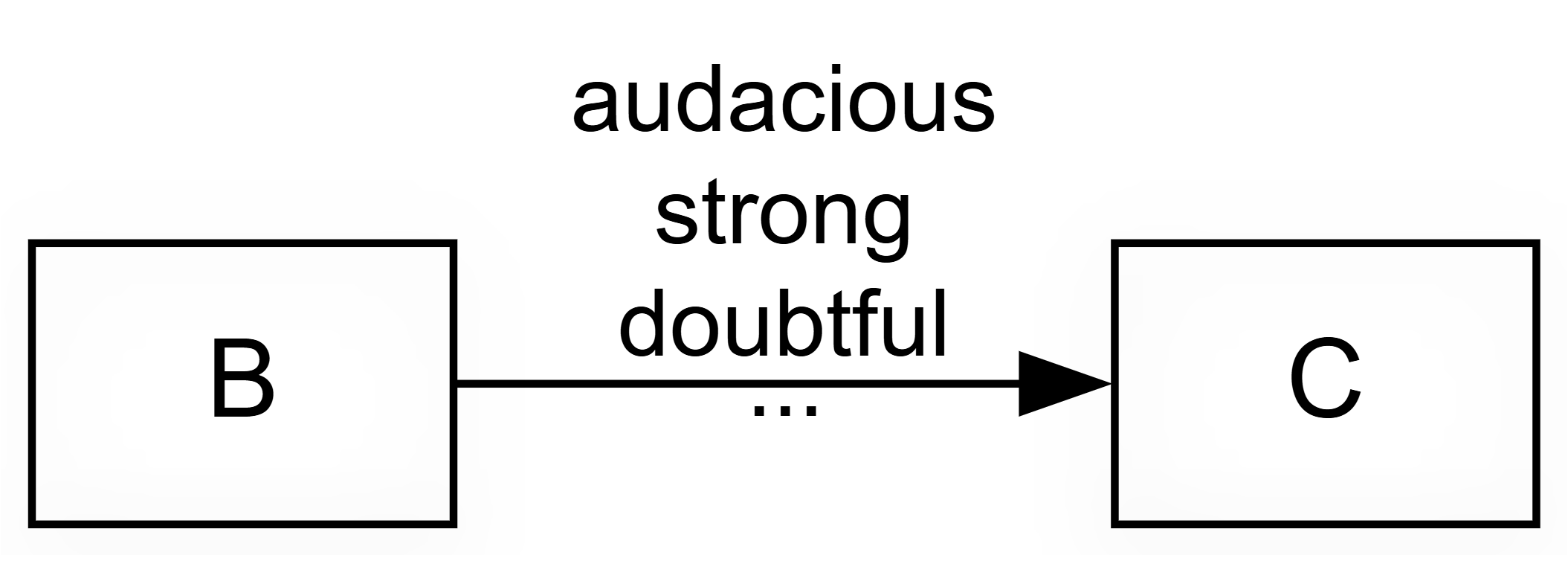
Start by tagging. A free tag such as #doubtful or #surprising records a misgiving you can filter on later.
Then add columns if they help:
- Conviction: how sure the source sounds (weak, neutral, strong). Most claims are unmarked, so most are neutral. This records how confident the source is; it does not measure the strength of the link.
- Strength: whether the source explicitly calls the influence strong or weak. Again, usually neutral.
Do not read these as scores like 1, 2, 3: neutral means "not mentioned", not "medium". That most people never mention strength does not mean they think it is medium; often the idea simply does not apply (on why we resist coding strength, see Our approach is minimalist — we do not code the strength of a link).
You can also score sources rather than links, for example reliability or role. Because every link has a source, those scores reach every link for filtering.
Steps 6 to 8: querying the model#
Your links are a queryable knowledge graph#
Your coded, checked links are not a static report; they are a model you can query, over and over, to answer different questions (see Causal mapping produces models you can query to answer questions). The links table is a knowledge graph: a network of factors joined by one kind of relation, "influences". Because the relation is always causal, a lot of evaluation questions can be answered almost out of the box, which is what a general-purpose knowledge graph cannot do (see Causal maps are knowledge graphs, but with wings).
The way you query it is with filters, and the key idea is that a filter is a question and filters chain. Each filter takes the links table and narrows or rewrites it; stack several and you build up the answer to a sophisticated question, where order usually matters (see Combining questions). It helps to picture the analysis as a pipeline, the links table passed through one transform after another:
Links |> filter to women only |> trace paths from training to income |> zoom to top level |> bundle |> show map
The same dataset yields very different maps with no contradiction, because each map is just the result of a different chain of filters. The minimalist coding paper develops this pipeline view in full (see Minimalist coding for causal mapping).
What you can ask#
Many questions answer themselves the moment coding is done, straight off the links. Some examples, each with its own page in the questions chapter:
- Which factors and links are mentioned most often or by the most sources?
- What are the main outcomes and main drivers?
- What leads to or follows from a factor you care about?
- How do groups differ, and are there hidden subgroups?
- What is surprising or emerging?
- What is the overall structure of the system, and are there feedback loops?
The three steps that follow are for the harder questions that need defensible answers, where you weigh the evidence rather than just count it. Here is where each kind lands.
| Question | Where |
|---|---|
| Top factors, drivers and outcomes; what influences or follows from X; group differences; surprises; network structure | straight off the links, from Step 5 |
| How robust is the evidence that X influences Y? | Step 6 |
| Pathways from X to Y, indirect ones included, without the transitivity trap | Step 7 |
| ; rival explanations; | Step 8 |
| A ; does the whole thing hold together? | Steps 7 and 8 |
Step 6: From claims to bundles#
A bundle is the set of claims that all say the same X influences Y, from different sources or different parts of one source. Whatever else you do, weighing each bundle as a whole is part of quality assurance: how many sources, how convincing, do they agree or pull apart? Always look at your bundles this way before you build on them. This step has its own paper: Assessing quality or robustness of evidence for a causal link based on a bundle of coterminal causal claims, and see also here.
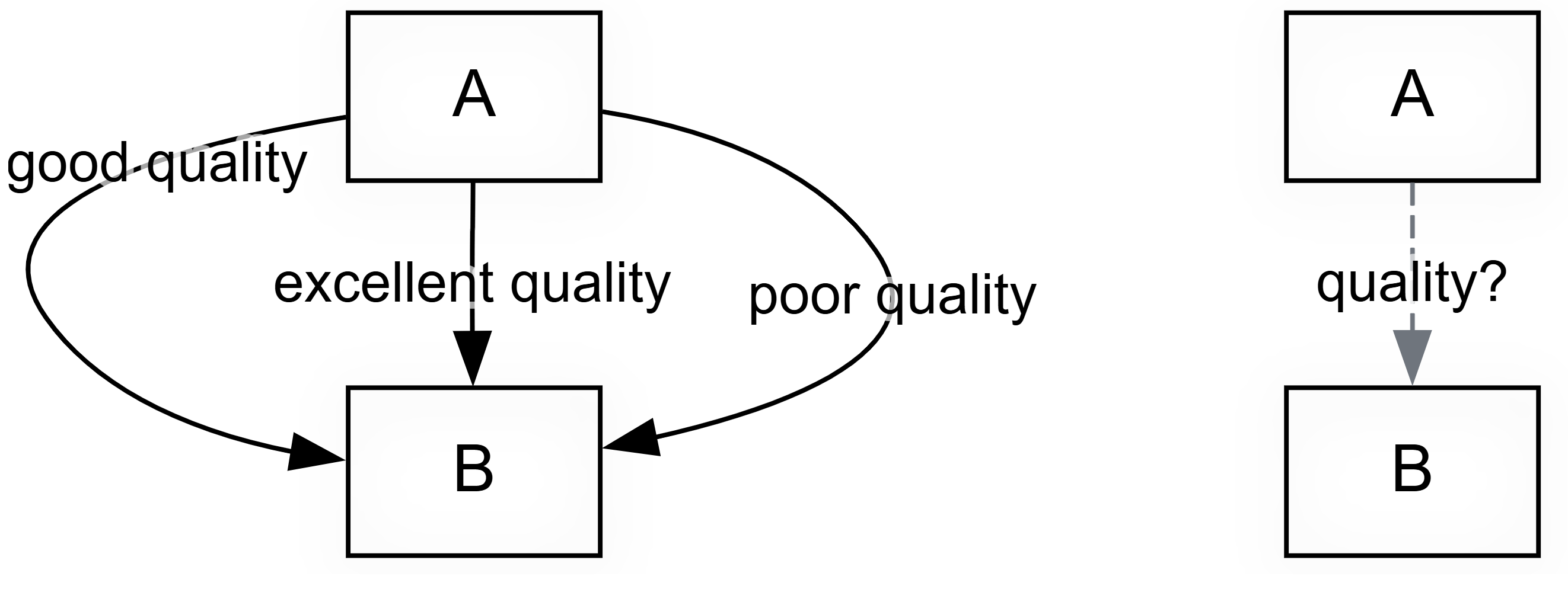
Once coding and cleaning are done, decide which bundles you will take seriously: the ones that survive your filters, perhaps after zooming to a higher level or restricting to certain sources. There might be five or a hundred. This is the evidence the rest of your analysis rests on.
You can stop there, having weighed the bundles by eye. Or you can record that judgement formally. Causal Map has a newer, optional feature that collapses a bundle into a single assessed link between the two factors, carrying your quality scores and, by default, the bundle's citation and source counts. The underlying claims are not deleted: a switch shows either the assessed links or the unassessed bundles, never both at once. Thin bundles can yield no assessed link, or one marked "Passed? = Fail".
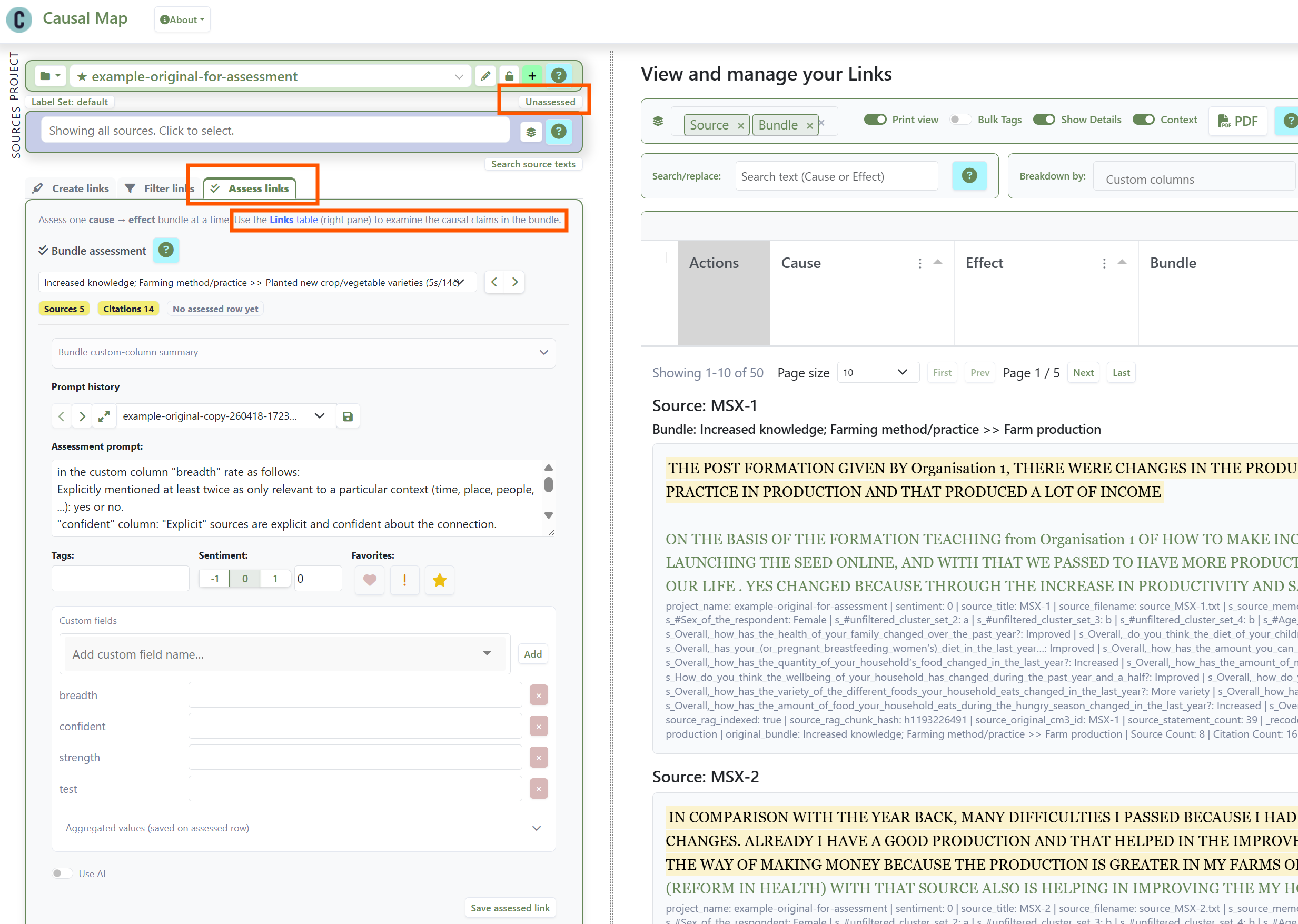
You can do this by hand, or let the AI take a first pass against your rubric and review it. The app will not create assessed links until you have written that rubric down, on purpose. The rubric can be a yes/no, a 1-to-5 scale like the one in Jewlya Lynn's seafood retrospective (Lynn 2025), or several dimensions such as confidence and triangulation.
Either way, formal or by eye, the move is the same: from a mass of raw claims to a smaller set you are willing to vouch for. A project might go from 1000 raw claims to 30 bundles to 25 assessed links, a much cleaner basis for argument.
Step 7: From bundles to pathways#
This step is about queries to answer more specific and sophisticated questions and is potentially also a move to causal inference.
Now you can ask about pathways, often indirect, from an intervention to an outcome.
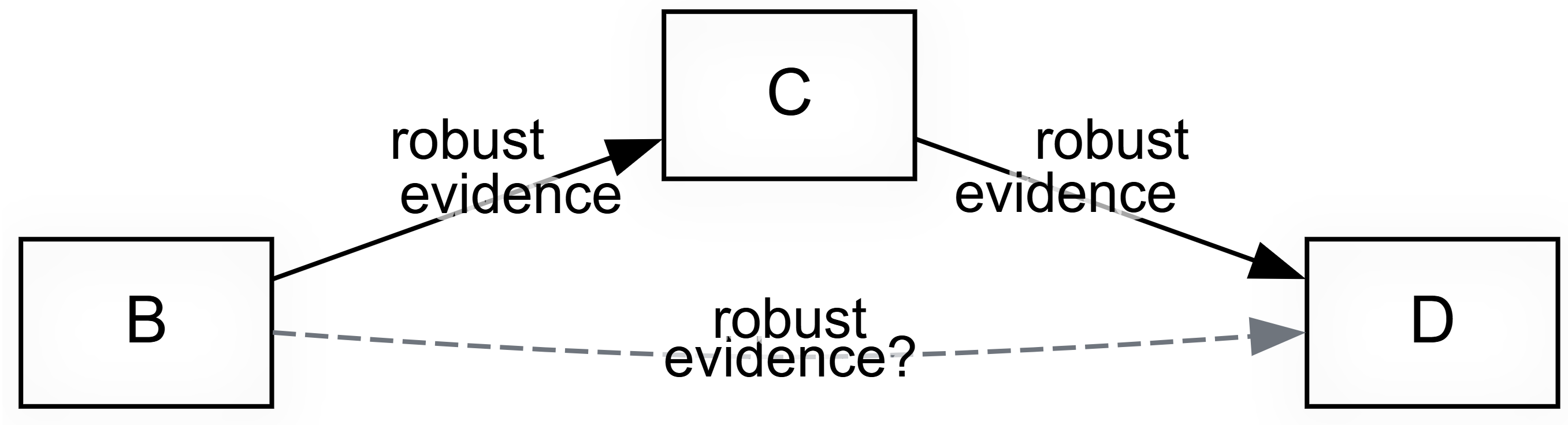
Even with every link well grounded you are not done, because conclusions usually run across a web of indirect links, from B1 and B2 to C via E, F and G. Two tools help.
Path tracing keeps only the links on some route between your chosen start and end factors, within a set number of steps (see Path tracing and source tracing).
But "A influenced B" and "B influenced C" does not give you "A influenced C": the contexts may not overlap. This is The transitivity trap, the biggest pitfall of any causal diagram, and the heart of the companion QA paper. Source tracing is the safe move: it keeps only sources whose own account runs all the way from A to C, so every link belongs to at least one complete story and you can review the evidence source by source.
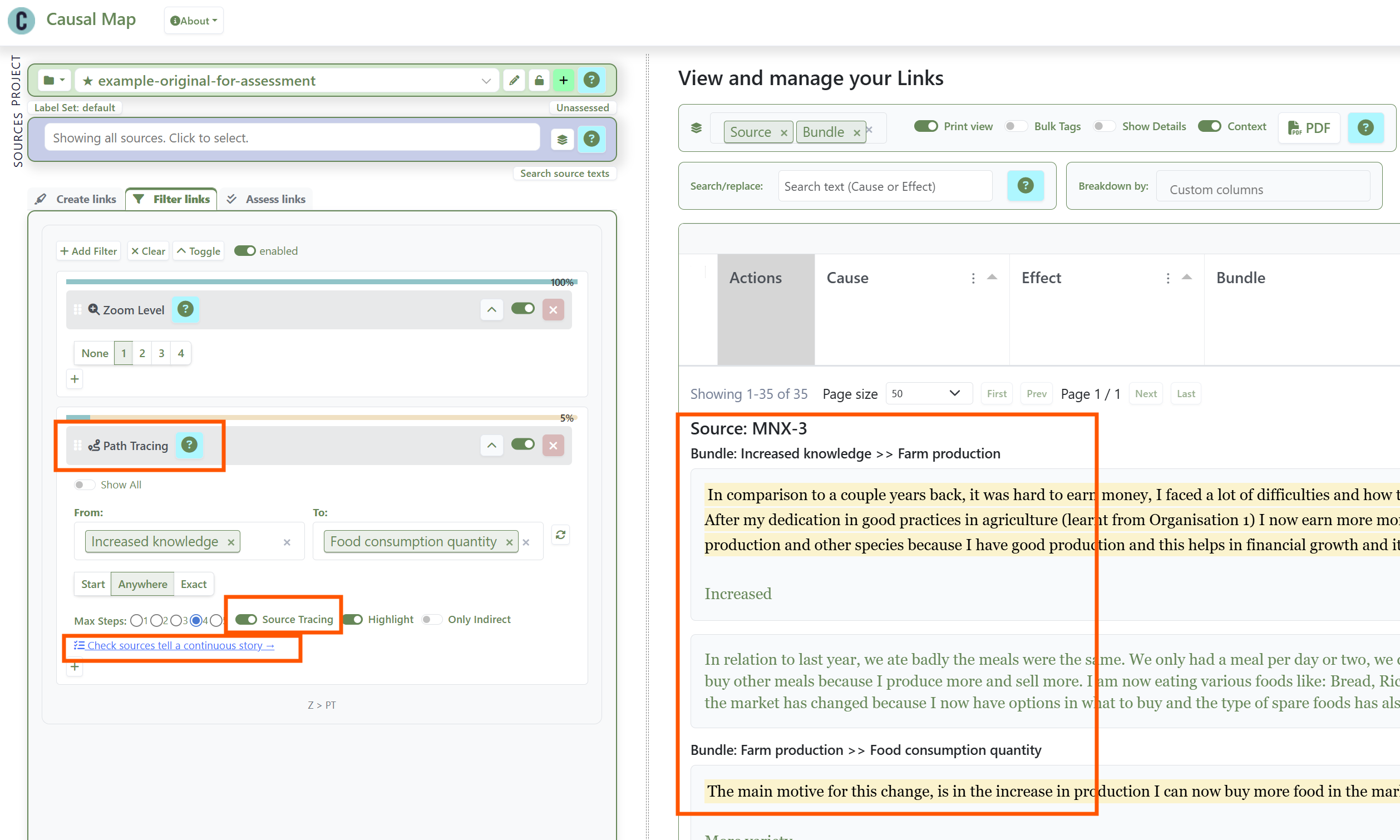 Setting up source tracing from Increased Knowledge to Food Consumption Quantity, and reading the narratives.
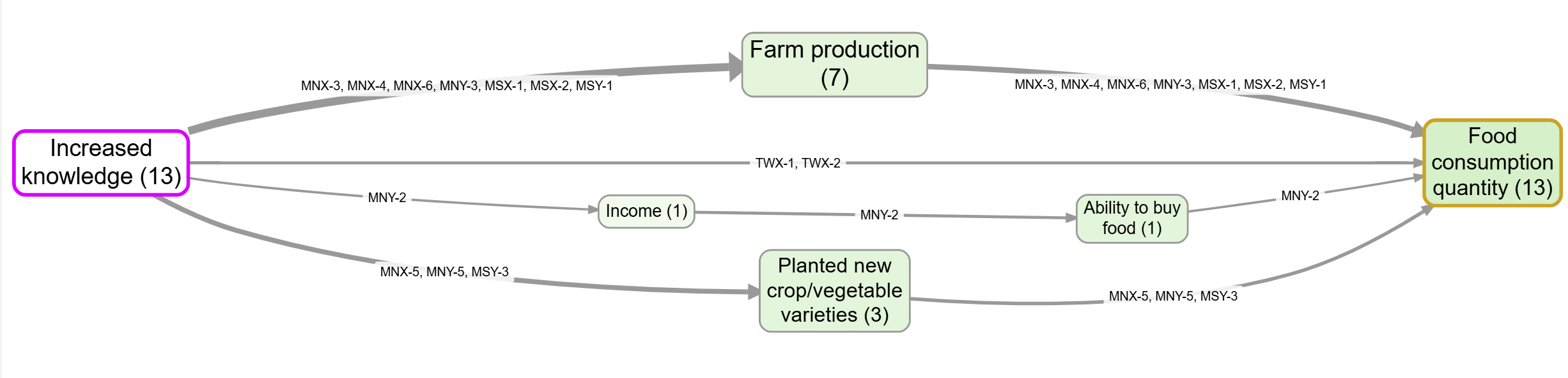 The matching map, here showing source IDs and counts for easy checking.
If you have assessed your bundles, you can trace on the assessed links (clean counts, no quotes) or the raw ones (quotes, busier map); often you will want both.
Step 8: Judge value, contribution and the final judgement#
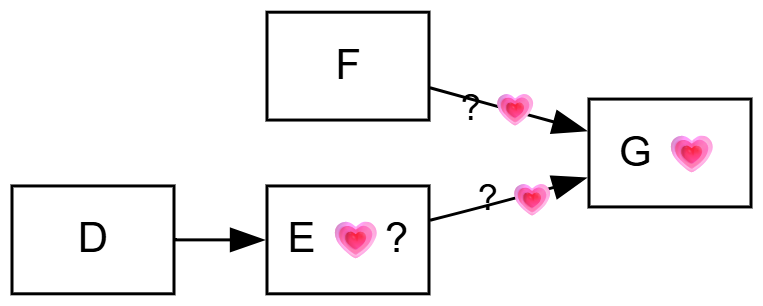
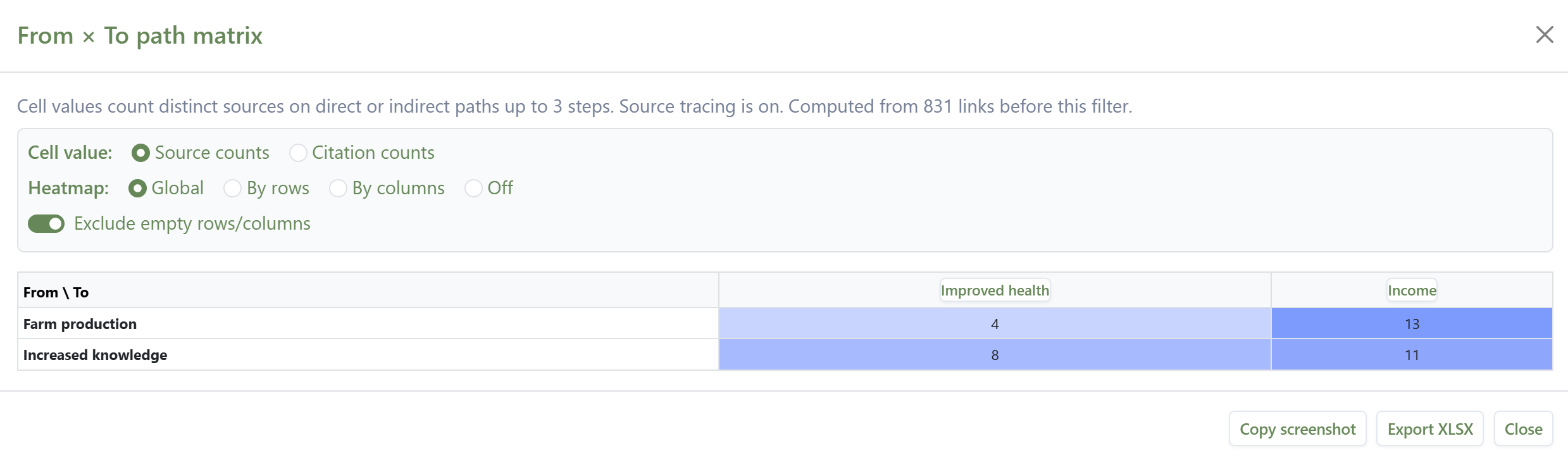
Judging how much something mattered, and weighing it against rival explanations, is central to evaluation and well covered elsewhere, not least by John Mayne (2019); QuIP has much to say on value (see Powell (2019)). The discipline is to compare your influence against the alternatives on the same map, not in isolation. For counting and comparing influences with path and source tracing, see Counting and comparing influences. For example, tracing the single-source narratives from two drivers to two outcomes:
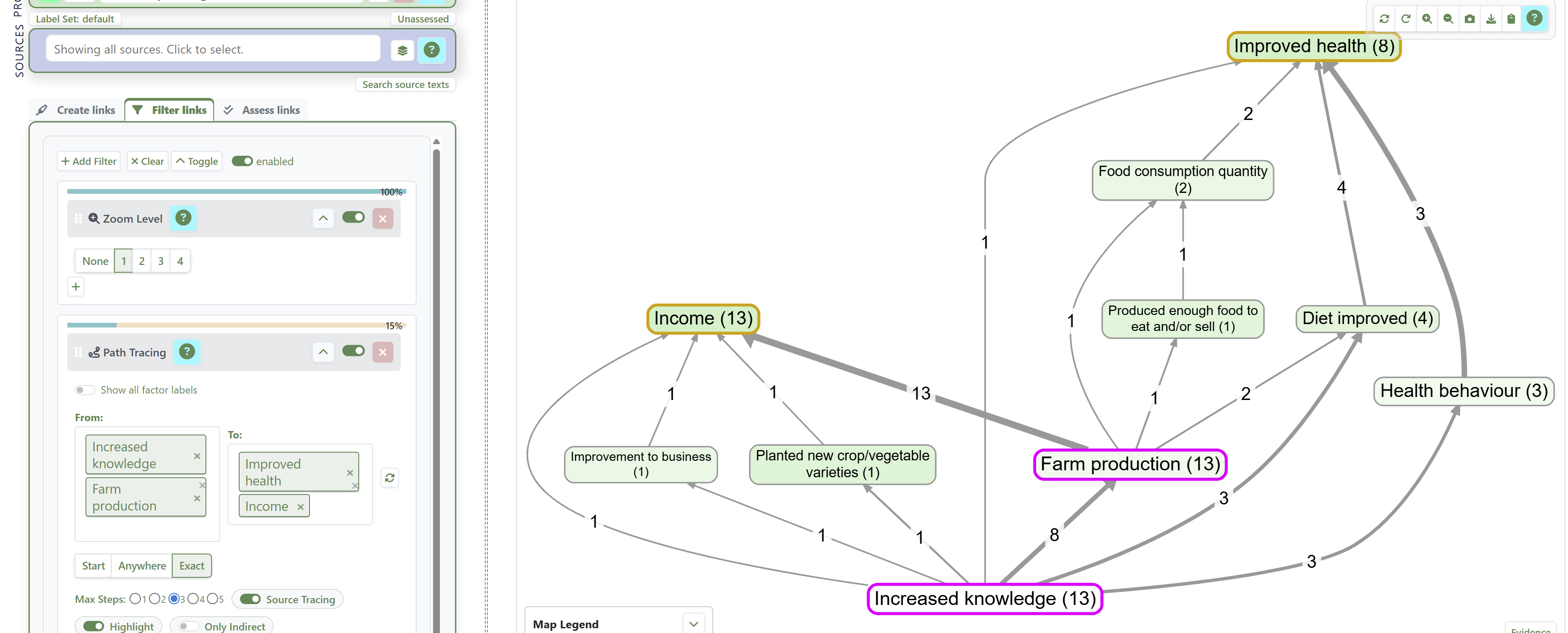
and counting the sources with a complete narrative between them:
Holistic final judgement#
Finally, draw the conclusion. You have checked the claims, assessed the bundles, traced the pathways and weighed the alternatives; now look at all the evidence at once and decide. Behind a single map there may still be hundreds of quotes. Does the claim hold up? Do all the links really belong to the same context?
The AI vignette feature helps: it drafts a commentary on a view, drawing on the underlying paths, links, quotes and source data, and can answer set questions, for example "is each link part of one coherent story from intervention to outcome?".
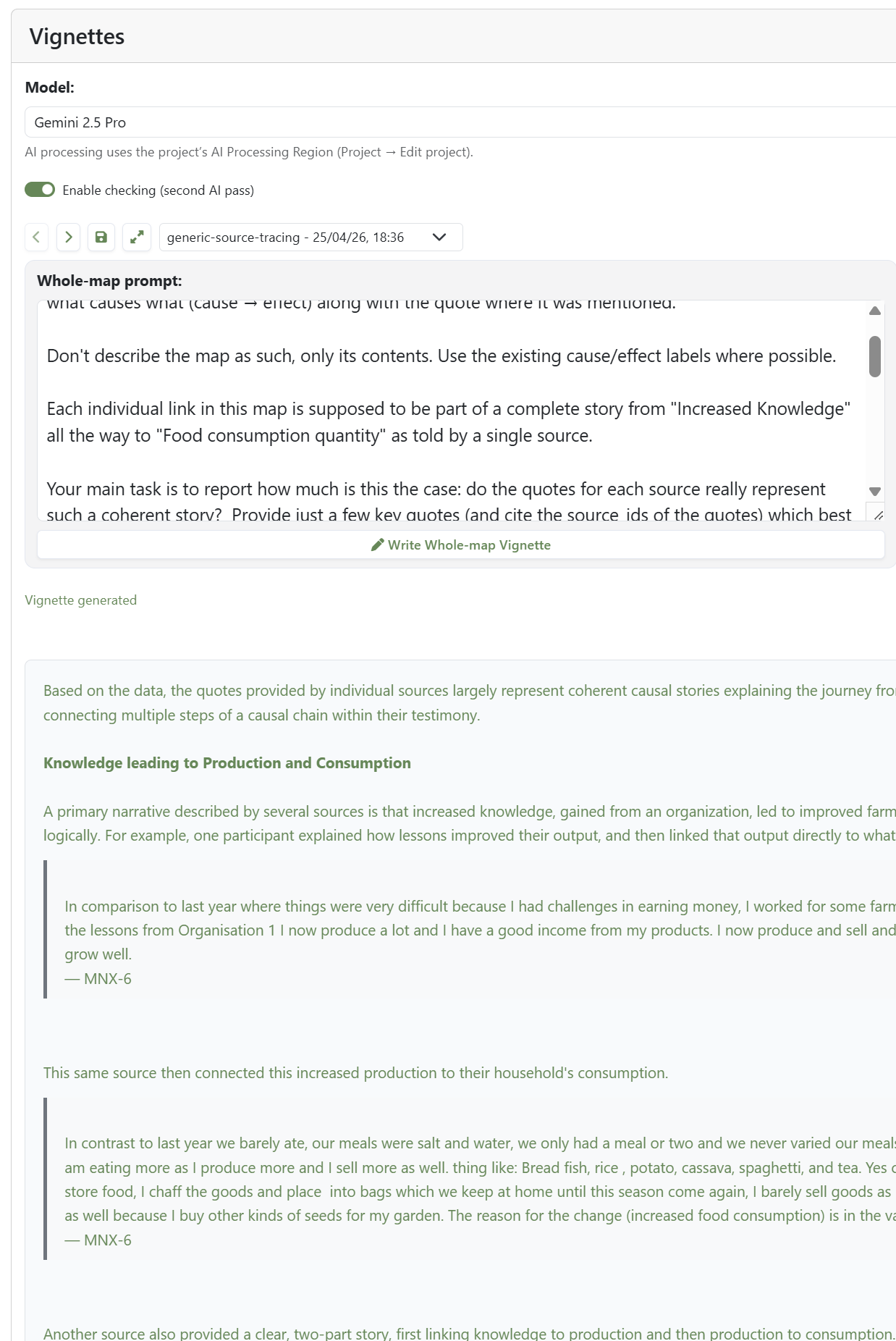
A common use is a source-by-source commentary on the pathways from an intervention to an outcome, judging how coherent each account is. The AI does only what a patient reader could do with the same quotes, so treat its draft as a starting point and edit it.
Then close the loop: does the evidence answer the question you set in Step 1?
References
Apgar (2024). A PARTICIPATORY APPROACH TO EXPLORING CAUSAL PATHWAYS Experience from the CLARISSA Programme July 2024.
Apgar, & Aston (2025). How Do We Define and Support Quality and Rigor in Causal Pathways Evaluation?.
Befani, & {Stedman-Bryce (2017). Process Tracing and Bayesian Updating for Impact Evaluation. Evaluation, 23, 42--60.
Britt, Powell, & Caldas Cabral (2025). Strengthening Outcome Harvesting with AI-Assisted Causal Mapping.
Collier (2011). Understanding Process Tracing. PS - Political Science and Politics, 44, 823--830. https://doi.org/10.1017/S1049096511001429.
Copestake, Morsink, & Remnant (2019). Attributing Development Impact: The Qualitative Impact Protocol Case Book. Practical Action Publishing.
Davies, & Dart (2005). The Most Significant Change Technique, A Guide to Its Use.
Lynn (2025). HU Seafood Retrospective.
Mayne (2012). Making Causal Claims. ILAC Brief, 26.
Mayne (2019). Assessing the Relative Importance of Causal Factors.
Pawson, & Tilley (1997). Realistic Evaluation. Sage Publications Limited.
Powell (2019). Theories of Change: Making Value Explicit. Journal of MultiDisciplinary Evaluation, 15, 53--54.
{Wilson-Grau (2018). Outcome Harvesting: Principles, Steps, and Evaluation Applications. IAP.